Homeowners' pick for appliance repair across the Northeast
Microwave Repair — Book a Visit Today
We repair microwaves that won't heat, won't power up, or spark inside, and we can come out after you're home from work. Most calls land in a few families: a magnetron that hums but won't heat, a failed door interlock switch, a burnt-out high-voltage diode or capacitor, a turntable motor that stopped spinning, or a control board with dead pads. Over-the-range units near the coast also fight rusted mounting brackets and greasy, scale-clogged vents. Our visit starts with the symptom you describe. Then we discharge the capacitor before any testing, and that part is not a DIY job. We check door latches, switches, fuses, and the control panel, then tell you what we found in plain words. Call us and describe what you hear.
Call (800) 967-1507- A real person answers
- Open 7 days
- Written quote before work starts
Taking calls until 5:00 PM ET
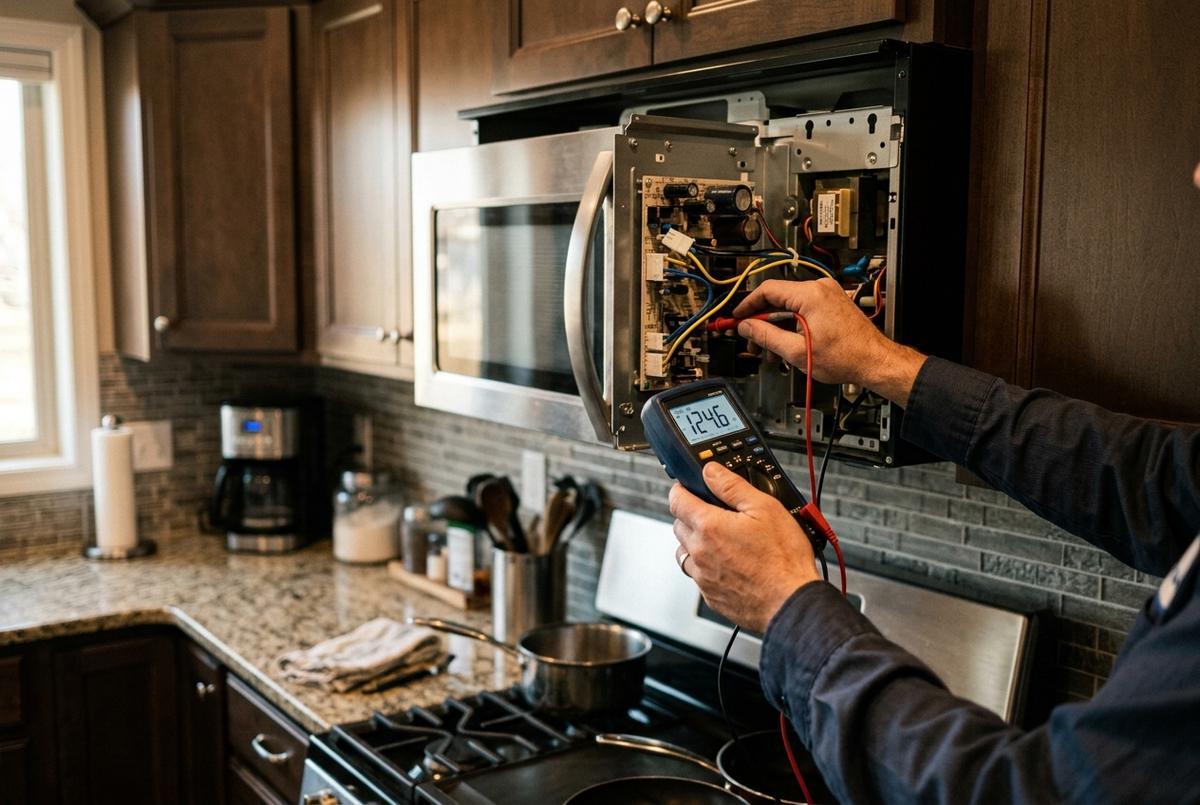
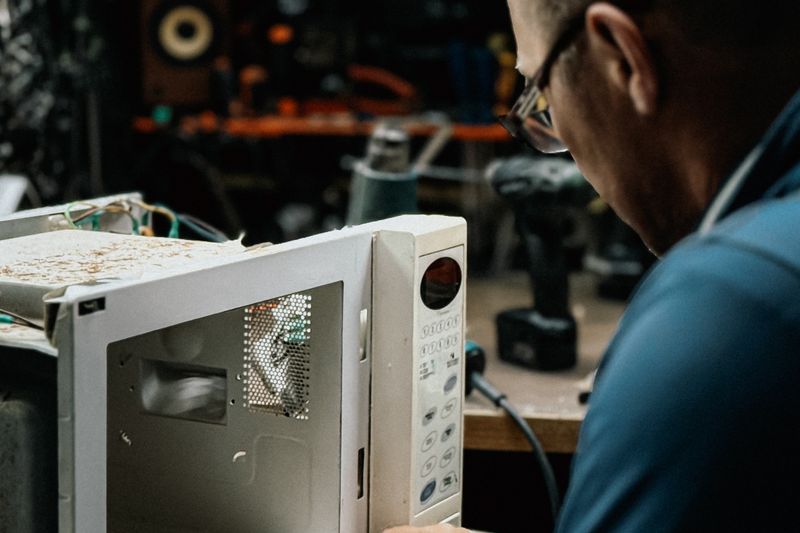
The microwave symptoms we hear most
- It runs but my food stays cold Magnetron, high-voltage diode, or capacitor failure somewhere in the heating circuit
- Totally dead, no light, no clock Blown line fuse, thermal cutout, or a tripped outlet feeding the unit
- Loud buzzing and a burnt smell Failing transformer, or arcing in the cavity from grease or a chipped waveguide cover
- Plate won't turn anymore Turntable motor, a stripped coupler, or debris jammed under the roller ring
- Door won't latch and it shuts off Worn interlock switches, or a cracked latch hook on the door assembly
Safe things to check first
Worth a look before you call — sometimes it saves you the visit.
- 1Reset the breaker or GFCI outlet the microwave shares, then try the start pad again.
- 2Wipe the door edge and latch area so nothing greasy is holding the door from seating fully.
- 3Heat one cup of water for one minute and note whether it warms at all. That separates power problems from heating problems.
- 4Look at the vent grille above an over-the-range unit for packed lint or grease blocking airflow.
Guides & troubleshooting
How an independent local shop compares
| Nassau Home Appliance Repair | Big-box repair chains | Handyman listings | |
|---|---|---|---|
| Quote in writing before a wrench comes out | ✓ | ✕ | ✕ |
| Phones answered by people, every day | ✓ | ✕ | ✓ |
| All major brands, gas and electric | ✓ | ✓ | ✕ |
| Independent, no manufacturer quotas | ✓ | ✕ | ✓ |
| Techs who know the local housing | ✓ | ✕ | ✓ |
Homeowners on how the visit went
“Two visits, one for diagnosis, one with the ordered part. Both on time, both explained clearly.”
Hannah B.North Stamford, CT“My tenants dealt with them directly and the whole repair happened without me leaving work.”
Victor A.Lowell, MA“The dryer vent was packed solid. Airflow now is night and day, and towels dry in one cycle.”
Joyce E.Edison, NJMicrowave Repair — quick answers
Is a microwave even worth repairing?
Often yes, especially built-in and over-the-range models, since replacing those means cabinet and venting work. Countertop units depend on which part failed. We tell you what we found and let you decide, no pressure either way.
Why can't I replace the magnetron myself?
The high-voltage capacitor can hold a dangerous charge long after the cord comes out of the wall. It has to be discharged with proper tools before anyone touches the wiring. We do that step first on every heating repair, then test the diode and transformer too.
Do you fix over-the-range and built-in microwaves?
Yes. Those need extra care coming down off the wall bracket, and on Long Island we often find mounting hardware corroded by salt air. We support the unit properly, service it, and re-hang it with the vent path clear.
Sparks came from inside. Should I keep using it?
Stop using it and unplug it. Arcing usually means a damaged waveguide cover, burnt food residue, or metal touching inside the cavity. Keep going and you can lose the magnetron. Call us and tell us where you saw the spark.
Can you come after I get home from work?
Evening windows are built into how we schedule, since most households here are out during commute hours. Tell us the earliest you're home and we'll aim for a window that fits, instead of making you take a day off.
What should I have ready when I call?
Model and serial numbers. They're usually on a sticker inside the door frame or on the back. Note what changed too: no heat, no power, odd noise, an error code on the display. That helps us bring likely parts along.
How it works
- Step 1
Tell us what it's doing
Describe the noise, the leak, or the error code on the panel. Brand and rough age help too. We use that to bring likely parts on the first trip instead of guessing in your kitchen.
- Step 2
Pick a window that works
Plenty of our neighbors leave before sunrise and get home after six. We schedule around trains and traffic, later slots included, so nobody burns a vacation day waiting on a repair van.
- Step 3
Diagnose, then repair
Our technician tests the machine, finds the failed part, and explains what's wrong in plain words. You approve the work before anything gets replaced. Most repairs finish during that same visit.
- A real person answers
- Open 7 days
- Written quote before work starts
Why homeowners call us
- Salt air is factored inCoastal humidity eats at terminals, brackets, and control boards. We look for corrosion behind the panel, not just the obvious broken part. Cleaned and protected connections help a repair hold up through another damp winter.
- Hard water knowledgeScale clogs dishwasher spray arms, coats heating elements, and stiffens water valves. If your dishes come out gritty or the washer fills slowly, mineral buildup is often behind it. We check for it every time.
- Wide service areaHomeowners across six Northeastern states call us for laundry, kitchen, and cooling work: refrigerators, freezers, washers, dryers, dishwashers, ovens, ranges, and cooktops. One number to call, whichever appliance quit on you.
- Straight talk on old unitsSometimes a repair makes clear sense. Sometimes the machine is worn past the point of value, and we say so. You get an honest read on the condition before you decide to fix or replace.
- All major brands, gas & electricOne independent crew for Whirlpool, Samsung, GE, LG, Maytag, Bosch and more.
- Straight answersIf replacing beats repairing, you hear it from us first.
Microwave Repair
Small faults become big ones on a schedule of their own
Describe the symptoms and we'll book the visit — takes about a minute.
- A real person answers
- Open 7 days
- Written quotes
- All major brands
- Gas & electric
Rather not call? Get a free quote →